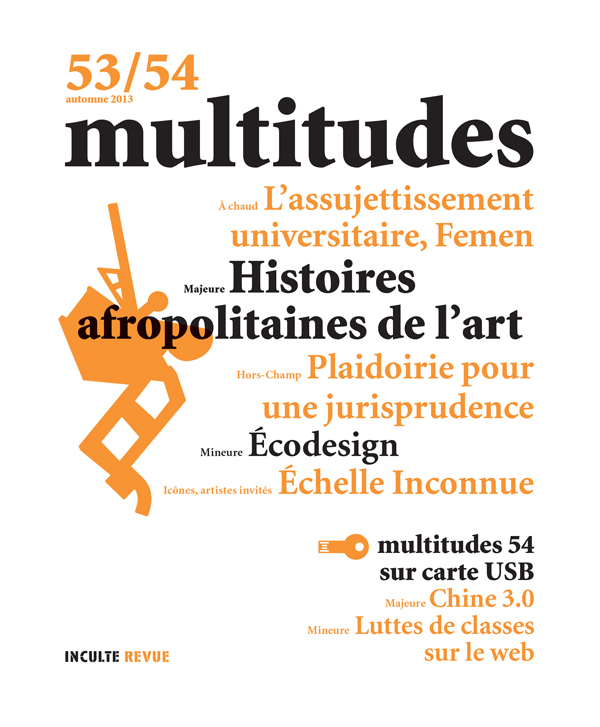

Double Issue 53-54, Fall 2013, Revue Multitudes
Majeure – Afropolitan Histories of Art
Edited by Kantuta Quirós et Aliocha Imhoff
Released : February 2014
SAVE THE DATE Pre-launching : Satursday, October 19, 2013,talk by John Peffer (Ramapo College, New Jersey, Etats-Unis) 6 pm, Galerie Dufay-Bonnet. Cité artisanale, 63 rue Daguerre – 75014 Paris
|
Dans ce contexte, la reconnaissance d’artistes contemporains d’origine africaine est allée croissante sur les scènes globales de l’art (musées, grandes expositions régionales panoramiques, collections privées, fondations, biennales, foires).
Elle a néanmoins souvent été coupée, et en France tout particulièrement, de la réception et la traduction de ressources discursives et pensées théoriques sur l’art, venues d’Afrique.
Ce premier volet d’un chantier de traductions choisit de s’intéresser à l’émergence, dans les années 1990, d’un « nouveau discours africain sur l’art », porté par une génération de commissaires, historiens et théoriciens de l’art, qui aura développé des plateformes discursives à forte valeur critique et choisi, en premier lieu, de réévaluer les modernités artistiques africaines.
Son discours sur l’art s’est ancré dans un refus de l’ « authenticité » et du « nativisme » et un projet de désessentialisation de l’Afrique. L’Afrique, comme « région géoesthétique » a été repensée, depuis un paradigme de mobilité (des populations et des flux culturels), que le penseur camerounais Achille Mbembé a théorisé, plus récemment, à partir du concept d’« afropolitanisme », envisagé comme une stylistique, une esthétique et une certaine poétique du monde.
Constitué de contributions originales autant que de traductions de quelques textes importants publiés ces vingt dernières années, sont discutés dans ce numéro la fonction de la critique d’art et des discours historiographiques sur l’art en Afrique, les politiques de la représentation, la relecture des modernités africaines et les discussions autour des catégories d’authenticité, de diaspora, d’afropolitanisme, ou de post black art pour penser l’art moderne et contemporain africain autant que des études monographiques et un entretien dédié au tournant éducationnel des nouvelles initiatives curatoriales en Afrique.
Kantuta Quiros & Aliocha Imhoff
Afropolitan Histories of Art
N°53 (version papier, in French):
Kantuta Quirós et Aliocha Imhoff, Historiographies de l’art, depuis l’Afrique (Fragments pour un chantier de traductions des discours africains sur l’art)
John Peffer, La diaspora des images de l’Afrique
Chika Okeke-Agulu, The Art Society et la construction du modernisme postcolonial au Nigéria
Sandy Prita Meier, Malaise dans l’authenticité: écrire les histoires « africaines » et « moyen-orientales » de l’art moderniste
Malick Ndiaye, l’Image théorique ou l’artiste face à l’Histoire.
Nana Adusei-Poku, «enraciné dans, mais pas limité par » – Les black artistes contemporains et l’évolution des conditions de la représentation
Olu Oguibe, La critique d’art et l’Afrique. Pensées pour un nouveau siècle.
N°54 (digital format):
Anitra Nettleton, Modernism, Primitivism and the search for Modernity: A 20th Century quandary for Black South African artists.
Pratiques curatoriales et tournant éducationnel. Entretien avec Koyo Kouoh, par Aliocha Imhoff et Kantuta Quirós
Olu Oguibe, Art Criticism and Africa. Thoughts toward a New Century
John Peffer, Africa’s Diasporas of Images
Sandy Prita Meier, Authenticity and Its Discontents: Making Modernist Art Histories “African”
Nana Adusei-Poku, ” rooted in, but not restricted by “ – Contemporary Black Artists and the Changing Conditions of Representation
Kantuta Quirós et Aliocha Imhoff, Art Historiographies, from Africa.
Since the late 1980s, the growing recognition, on the global art scene, of long neglected contemporary artists of African origin went hand in hand with an exaltation of multiculturalism, erasing the borders which divide the art world. The reception granted to these artists, in particular in France, was severed from the reception of the theoretical resources which reframed art from an African perspective. This article introduces a wider project of translation of historiographic discourses and African views on art, documenting the emergence, in the 1990s, of a “New African discourse” on art, carried by a generation of curators, historians and theorists who chose to reevaluate the various trends of modern African art.
John Peffer, Africa’s Diasporas of Images
This essay addresses the concept of a history for African art objects by thinking them across space and time as vehicles for “diasporas” of images. John Peffer proposes a consideration of African art from the perspective of diaspora, as objects in motion, and as objects that articulate between and across disparate cultural histories and the cultural zones of others. In the process, John Peffer attempts to bridge the continuum spanning arts otherwise categorized as “traditional” or “contemporary”.
Chika Okeke Agulu, The Art Society and the Making of Postcolonial Modernism in Nigeria
This essay focuses on the work of the Art Society – a group formed by art students at the Nigerian College of Art, Science, and Technology, Zaria (1957-61) – and suggests that the work of its key members in the 1960s was the first significant manifestation of postcolonial modernism in Nigeria. Postcolonial modernism, the essay argues, refers to a set of formal and critical attitudes adopted by African and black artists at the dawn of political independence as a countermeasure against the threat of loss of self in the maelstrom unleashed by Western cultural imperialism and its aftermath. In defining their relationship with European and African artistic heritages, the Art Society and other postcolonial artists emphasized the importance of local and indigenous artistic resources in the making of their decidedly modernist work. The essay details the convening of the postcolonial literary and artistic avant-garde at the Mbari Artists and Writers Club, Ibadan, Nigeria, in the early 1960s and claims that their modernism was directly linked to the practice and rhetoric of political and cultural decolonization and sovereignty. Further, the essay argues that in recognizing and advocating the equal validity of the plastic and conceptual potential of indigenous African, non-Western, and European artistic traditions in the construction of the modern, the Art Society and its contemporaries testified to modernism’s transnational and multicultural foundations. It suggests that the exploration of the historical implications of the encounter with multiple, sometimes contradictory logics o
f politics, art, and culture involves what the author describes as compound consciousness – the willful incorporation and critical resolution of the alienation and fragmented subjectivity produced by the colonial experience.
Sandy Prita Meier, Authenticity and Its Discontents : Making Modernist Art Histories “African” and “Middle Eastern”
In her article, Sandy Prita Meier establishes some of the central theoretical concerns that frame this issue, particularly noting the overlaps and divergences that have shaped “African” and “Middle Eastern” modernisms within the discipline of art history. She rereads the multiple ways in which, curators, critics, and scholars have contended with questions surrounding the “modern” over the last two decades. Meier highlights the “multiple modernities” model as a strategic position for both excising the continued anxiety about “authenticity” and moving beyond the “particularism and universalism” to which art historical inquiry is all too closely wedded to.
Nana Adusei-Poku, “rooted in, but not restricted by” – Contemporary Black Artists and the Changing Conditions of Representation
Blackness was and is still en vogue in the beginning of the 21st century, not only in popular culture but also in the arts, which synchronically reproduces classical stereotypes about the Black body and challenges Black artists and scholars not to fall into already established counter-discourses but rather expand the repertoires of representations. This article thus aims to explore the difficulties and intricacies of the idea of post-black art and its curatorial legacy, which was introduced as a curatorial concept in 2001. Additionally, it examines the option of opening up the debate into a wider discourse of identity politics, their various meanings, limitations and promises for the contemporary. The article is framed by a series of questions that are fundamental to understanding the complexity of the idea of post-black. Nana Adusei-Poku foregrounds the discussion with the general considerations “What is post-black art ?” and “What is meant by ‘black’ in post-black art ?”
Malick Ndiaye, L’image théorique ou l’artiste face à l’Histoire.
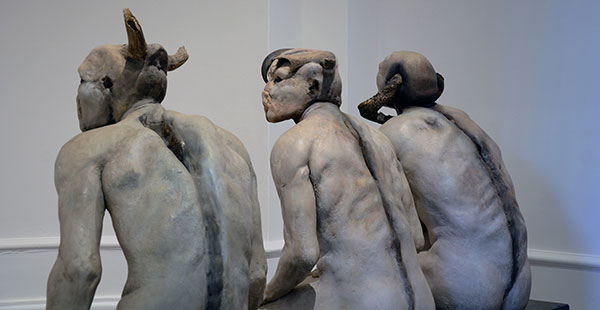
This paper attempts to demonstrate the theoretical nature of artwork from Jane Alexander’s Butcher boys. The formal indeterminacy of this artwork is related to the ambivalence as mentioned by Homi Bhabha about deconstructionist theory. The author underlines the influence of poststructuralist theory on postcolonial discourse and considers the hypothesis that the problem of ambivalence and the critic of temporality are the main ideas that get Butcher boys in the center of postcolonial deconstructionism. From this point of view, the artwork is analyzed in relation to Time, Memory and History in view of South Africa’s historical events. The author demonstrates what he names the corporeity of memory as the support of making history.
Olu Oguibe, Art Criticism and Africa. Thoughts toward a New Century
“At the time, I had taken what many saw as a hardline, uncompromising position in arguing that the business of the state of art criticism in Africa should be left with the Africans. It was my opinion, too, that this business is one that ideally should be conducted in Africa. The very idea of discussing art criticism and Africa in London or New York did not seem particularly appropriate to me then. Neither does it now. It is, I believe, a reflection of the sad state of that continent and its leaders that five years on it has fallen on us again to speak about art criticism and Africa outside the continent.” Olu Oguibe. Keynote speech delivered at the International Association of Art Critics Conference, Courtauld Institute, London, November 1996.
Anitra Nettleton, Modernism, Primitivism and the search for Modernity : A 20th Century quandary for Black South African artists.
In this article, Anitra Nettelton explores the ways in which the relationship between modernity and modernism played out in two different manifestations in successive generations of black South African modernist artists in the mid-20th Century, but do so against a broader background of a settler society. The two artists considered here are Sydney Kumalo and Lucky Sibiya, both of whom enjoyed some degree of commercial success within South Africa and abroad and both of whom died relatively young. They have been neglected as contributors to the history of modernism in South African art since 1994. The article addressed the contexts in which they were working to propose that the reasons for this neglect lay in the difficulties experience by black artists who espoused forms of modernism that arose out of primitivist readings of the art of Africa.
Educational Turn in Curating – Interview with Koyo Kouoh (by Aliocha Imhoff and Kantuta Quirós)
This interview looks at the increasing development of educational programmes in curatorial and exhibition practices in Africa. By addressing a new wave of curatorial practices, this interview asserts that curating increasingly operates as an expanded educational praxis. In Africa, this is evident in the increase of curatorial workshops, immaterial and research-based artistic projects, participative and collaborative museology and the emergence of curatorial courses across a range of disciplines. This interview with Koyo Kouh, founder of the Raw Material Company, center for art, knowledge and society in Dakar contributes a critical reflection in this on going curatorial discourse through its public forums.
Biolines
Aliocha Imhoff is a curator, based in Paris. Cofounder of the curatorial platform le peuple qui manque – a people is missing, he was curator of numerous events (exhibitions, international symposiums, festivals, retrospectives and cycles of screenings) : (recently) A Thousand Years of NonLinear History (Centre Pompidou), The Borderscape Room (Le Quartier), Make an Effort to Remember. Or, Failing That, Invent. (Bétonsalon – Centre d’art et de recherche, Paris), The Artist as Ethnographer (musée du quai Branly, Centre Pompidou), What is to be done ? Art/film/politics (Centre Pompidou, Palais de Tokyo,…), Critical Atlas (Centre d’art du Parc Saint-Leger). He is currently PhD Candidate at Paris 1 Panthéon-Sorbonne in Philosophy of Art. His doctoral research is considering contemporary art as site for knowledge production and the uses of theoretical fictions in postconceptual performance. He is member of the network Resea
rch and Globalization led by Centre Pompidou / Musée National d’Art Moderne.
Docteur en histoire et critique des arts de l’Université Rennes II et diplômé de l’Institut National du Patrimoine de Paris (conservateur, spécialité Musées), Malick Ndiaye est postdoctorant du Labex Création, Arts et Patrimoine. Il est affilié au Centre de Recherches sur les Arts et le Langage (CRAL. EHESS/CNRS) et associé à l’Institut National du Patrimoine. Il a été boursier dans le programme Art et Mondialisation de l’Institut National d’Histoire de l’Art et collaborateur scientifique dans le cadre des trente ans du Centre Georges Pompidou. Spécialiste des arts contemporains, patrimoines africains et études postcoloniales, il participe à plusieurs rencontres internationales, collabore avec des revues et coordonne différentes activités scientifiques autour de ces thématiques.
Chika Okeke-Agulu is Associate Professor in the Department of Art & Archaeology and Center for African American Studies, Princeton University, and co-editor of Nka: Journal of Contemporary African Art. He is co-author of Contemporary African Art Since 1980 (Damiani, 2009), and co-editor of Who Knows Tomorrow (Konig, 2010) and Ezumeezu: Essays on Nigerian Art & Architecture, a Festschrift in Honour of Demas Nwoko (Goldline & Jacobs, 2012).
Sandy Prita Meier is Assistant Professor of African art at the University of Illinois at Urbana-Champaign. Her research focuses on the politics of globalization and modernity in east Africa. She has a book in preparation titled Architecture of the Elsewhere: Swahili Port Cities, Empire and Desire and has publications in African Arts, Nka: Journal of Contemporary African Art.
Kantuta Quirós is a cultural critic and curator, based in Paris. Her recent curatorial projects, within the curatorial platform le peuple qui manque – a people is missing, are dedicated to epistemocritical inquiries in knowledge and human sciences by contemporary artists. She co-edited (with Aliocha Imhoff) the book Géoesthétique dedicated to spatial turn in art (Editions B42, 2013) and is currently PhD Candidate in Philosophy of Art (Université Paris 1 Panthéon-Sorbonne). She worked for several cultural institutions (e.g. from 2007 to 2011 for Département Cinéma du Musée National d’Art Moderne – Centre Pompidou), was a lecturer at Paris VIII University and directs the seminar Artist as Historian. Writing of History and Narrative Devices at l’Ecole Supérieure des Beaux-Arts de Nantes Métropole. She is member of the network Research and Globalization led by Centre Pompidou / Musée National d’Art Moderne.
Translations by Thierry Baudouin, Julienne Lemb, Isabelle Montin, Kantuta Quiros